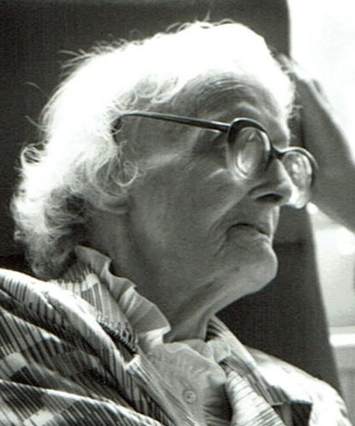
As I think of Kirstie's life, my mind ranges through the century almost all of which she spanned with its amazing accelerating changes into its present stage of globalisation. She, and her colleagues, have done their part in shaping lt, through the teaching which has sharpened the issues and kindled the zest of those who would, and will, play their crucial part in their stage of the future,
One way of looking at it is decade by decade. This could be part of a study or comment on Oxford itself through our time. lt may be too large a framework for one afternoon, but lt may point to the setting for individual reminscences of her charm and stimulus and enduring influence.
I look back myself over a similar period, bar a few years - a different but parallel exposure to the same stream of events. This is irrelevant, but adds relish to my own reception of the many tributes to her that are coming my way.
1903 saw Kirstie's birth in 'Ooty', famous part of the Raj, and her arrival in St.Andrews aged three. Her grandparents - Professor and Mrs Meiklejohn - he of the famous lecture on 'the hoodwink' - gave much to the three Morrison girls, who went to St Leonard's School (which 1 hope will be represented at the 'celebration.')
Scottish cousins will be present. Should a piper pipe us in from tea to the hall?
1920's. Kirstie came up to Oxford in 1923 - as a Home Student. Her landlady's daughter remembers her arrival, and may be present, with her daughter Kirstie's godchild. Her tutor Margaret Lee is worthy of mention.
Oxford was expanding - not only in its recent admission of the role of women, but in the comparatively new English faculty and in the broadening of its class structure. In all this the Home Students played their part.
1930's. Having gained a brilliant First, Kirstie was appointed as Tutor in 1931. She successfully enlisted the support of such figures as CS Lewis, David Cecil and Tolkien in tutoring her pupils, Among the first of these were two nuns, pioneers of many more to whom St Anne's gave an Oxford experience. Mother (Bertha) Maude astonished many by reading the Chancellor's Essay Prize at Encaenia in 1933 - on 18th Century Coffee Houses in London.
'Dreaming spires' were not an option for the Oxford of Kirstie's generation. Conflicting views of the darkening world scene were the subject of debate in junior and senior common rooms alike as the clash of ideologies created the scenario for World War 2, and later the Cold War. Kirstie's choice lay in helping to shape a small but influential group which surprisingly by the end of the Thirties, according to the latest volume of the 'History of the University of Oxford', had become 'a world-wide movement of considerable influence.' ( This was the controversial Oxford Group, In this connection she was closely associated with Dr and Mrs BH Streeter, Provost of Queen's.)
1940's. Kirstie's 'War' was spent in Oxford. Among the many service men and women in and out of 12A Norham Road was Michael Thwaites, winner of the Newdigate in 1938, and of the King's Medal for Poetry in 1947, his war years being spent in the Navy. Kirstie was at his wedding in Oxford, and he is here again to pay his tribute.
1950's. St Anne's became a full college. The buildings, the Queen's visit. Marjorie Reeves, colleague since 1938, can speak of this.
1960's. A distinctive development in Kirstie's last decade of lectures: ten series on the relation between Art and Poetry.
1970-1998. Retirement, the beginning of 28 years of less formal, yet continuous, stimulus and inspiration given to friends young and old. One notable feature - her love for Egypt, (through students at St Anne's, especially Fayza Halka?), and her part in starting the British Arab University Association, entertaining every visiting party of students over 25 years, the last being in July 1997. Her last visit to the College was to entertain to lunch these 6 students and 4rofessor from the University of Bethlehem.
1990's. lt was to the beloved hills of Fife and the waters of the Forth that her spirit would return nightly in her latter years; to find herself back in familiar Norham Road and Park Town was an effort. Music she loved: classical, orchestral,and the fun of Gilbert and Sullivan; an old Scottish chorus that was a favourite at St Leonard's, 'Pull, pull for the shore'; spirituals, especially 'There is a balm in Gilead'.
PS The latest letter received: from the Rev Paul Rimmer, another of the many service men and warnen who found support in 12A. 'Kirstie was one of the first people 1 met when I came up as an undergraduate (part-time Navy ) during the war. The assembled 'group' met in her flat - I think on a Thursday evening - and were told that a young man with the surname 'Rimmon' was joining them. Julian Thornton Duesbery said they wondered (until they found my name was 'Rimmer') whether they were all expected to 'bow down in the house of Rimmon!.' Memorable to many are parties in that upstairs sitting room - from 'Musical Hats' to poetry and life-long encounters.
Charis Waddy, 12 Norham Road, Oxford 0X2 6SF, 23/10/98

English