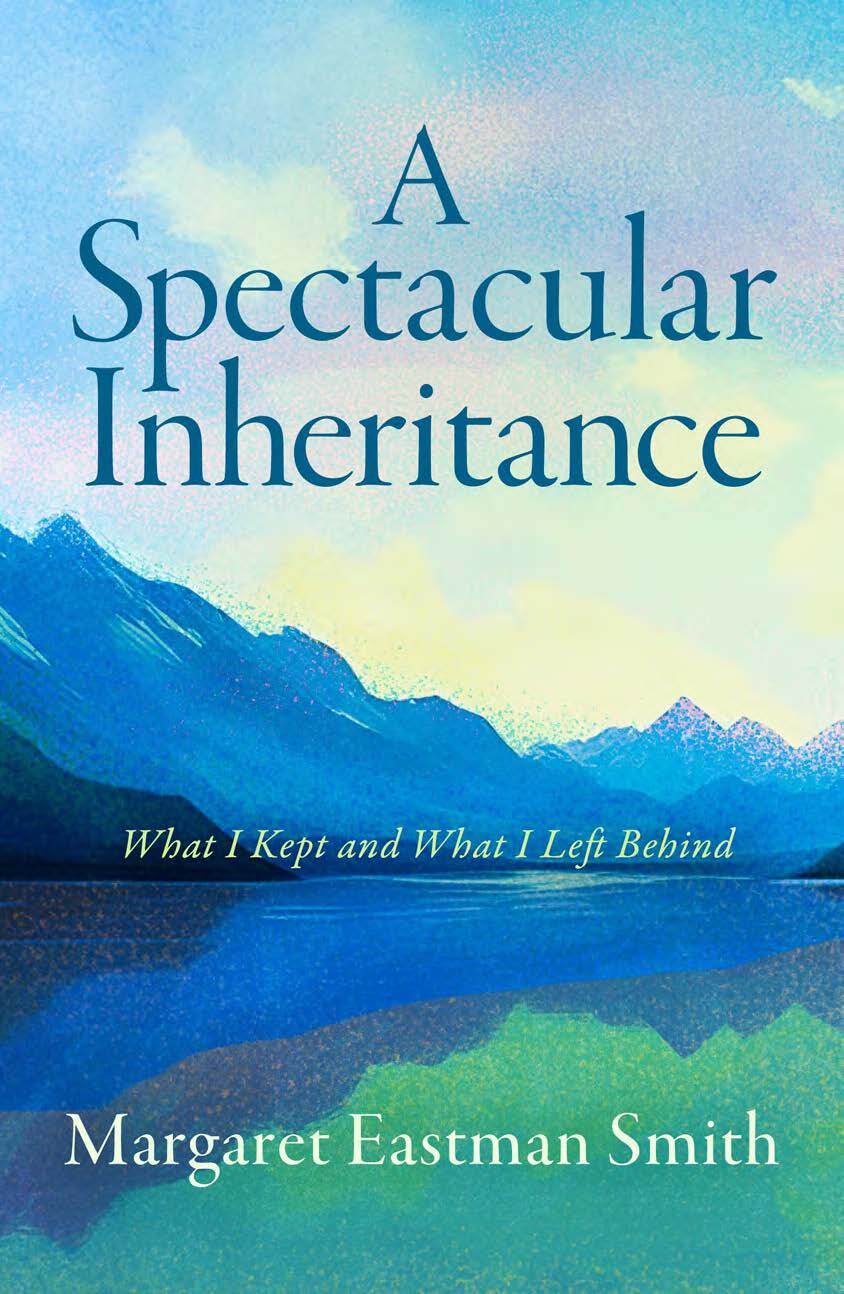
Margaret Eastman Smith offers us a painfully honest memoir of her family’s immersion in the community of the Oxford Group and Moral Re-Armament and her upbringing and adulthood in the movement. The book is beautifully and imaginatively written, with great compassion for her parents and those who caused her such pain and trauma. She shares with her readers from a life-time of hard-won wisdom. This is an important book, with precious insights, understanding and historical perceptions about this little-studied movement. Important for all those still travelling, still searching to make sense and meaning in their lives; perhaps offering more questions than answers! It includes a mass of fascinating footnotes and an excellent bibliography.
Well into her adult life, she steps out of the community and launches out on an academic career, quickly realizing what virgin territory she is treading. She cannot find in her past “a time when [the community’s] compelling image of life was not part of me, when I was just myself, without the imprint of a grand mission arranging my understanding of who I was". She questions herself about the new life she has embraced but notices the “internal voice” that insists that in this departure “I am obeying the call to be true to what I most deeply feel—perhaps for the first time ever.”
She details her struggles but doesn’t cast herself as a feminist. Rather: “I vaguely see my situation in the traditional masculine sense of the mythic ‘hero’s journey,’ the call to an adventure where the protagonist enters the forest of life, is tested in many ways, finds some deeper truth, and brings it home, demonstrating upon return a fuller sense of self and of insight about life.” That said, a number of her vignettes demonstrate a growing consciousness of matters that feminism underlines.
Another major theme of the book is home, coming home, finding home, searching for home. Brought up in a series of communal arrangements that meant she never saw her parents in charge of their own home until she had passed her mid-twenties, she notes that “Living in other people’s homes had created permanent temporariness.” In the end she concludes: “the wilderness will forever be the place I know best”.
She analyses her father’s generation, forged by two World Wars. Her father had no memory of his father: he was four years old when his father came home from British-occupied Rhineland at the end of the First World War with advanced cancer, and died leaving six children fatherless. She has grown up with a consciousness of the strength and self-discipline required of so many families bereaved by that war. “The cult of strength had promoted other required male behaviours: decisiveness, limited expression of feeling, withholding of tears.” Claudia, her therapist, suggests that male energy was predominant in the world of Moral Re-Armament: abstract spirituality, theoretical dedication, blind courage.
One older friend within the community, Anglican pastor and playwright Alan Thornhill, gives her a feeling of being loved for herself when he tells Margaret that she is “God’s love child”. She is less touched by his recitation of the oft repeated Christian aphorism that we must lose our life in order to find it. She doesn’t yet have a life of her own, so losing it doesn’t make sense. Over time she recognizes the real meaning of this piece of truth: that she must be “careful not to hang onto some things so tightly that I miss the true majesty of being alive”.
There’s a lot of simple wisdom. “It is a liberation to discover that we are not, essentially, called upon to reveal and underline people’s mistakes, but rather to affirm others and allow them to feel the full expression of their inner life.” She senses that many members of her community have “prevented themselves from experiencing the unadulterated uncertainties of the human condition”.
Freud tells us, she says, that in order to mourn we must know what we have lost. So she puts out “a tentative hand to the child lost in the haze. It is time to feel one with her, feel her lostness as the truest feeling I know. In making friends with that child, I can savour each feeling with her, and we can together make the journey from emptiness, through anxiety, fear, and confusion, to sadness. Sadness, we know, brings us close to the end stage of grief. It is a sweet place, holding the safety of home.”
Wound through the very personal story that is the heart of this book, Margaret offers incisive reflections about the movement and its founder, Frank Buchman, who was a friend of her parents and grandparents, but, she feels, has cast a shadow over her life and her parent’s lives. She reflects on Buchman’s failure to prepare the movement for a leadership arrangement after his death, and notes “I did not see signals in Buchman’s last years of a man who was becoming deeper or broader in his understanding of himself and others”. She blames some of the movement’s difficulties on its naivete about group dynamics. Buchman, she says, “failed to recognize that to be authentic in a group, debate must be welcomed to offset the tenacity of the culture”. Buchman’s “shunning leadership structure in the movement allowed things to be more communitarian, but in fact this allowed strong personalities to have free reign and rivalries to fume below the surface.”
There’s a surprise happy end, an “Epilogue” – but I won’t spoil the fun by saying anything more. As a retired publisher myself, I have to add that this is a beautifully designed and typeset book, by a publishing house that I’m discovering, “Publishing the brilliant work of women authors over 50”. And that slogan certainly can be applied to this book. Andrew Stallybrass, Retired Director of Caux Books and MRA/IofC historian
The book can be ordered from Amazon
English