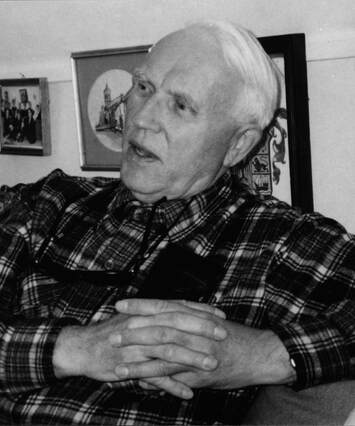
Talk by Philip Boobbyer, Men’s Prayer Group ‘Heroes of Faith’ series, St Mary Bredin Church, Canterbury, 25 September 2026
In April 1989, I went to Moscow as the translator for an elderly Norwegian called Leif Hovelsen, a Lutheran Christian and veteran of Norway’s wartime Resistance against Hitler, who was visiting Russia for the first time. I had studied Russian in Moscow a few years earlier, so I knew how to get around the city. Our aim was to get a firsthand feel for what was going on in the Soviet Union under its reforming leader Mikhail Gorbachev. We had a list of people to look up, many of them linked to dissident circles. For this reason, we felt slightly tense: the USSR was, after all, an authoritarian state and we assumed that we would be watched. When we got there, we were so worried about possible listening devices in our hotel room that I went out into the street to arrange our meetings from small telephone kiosks where security service bugs were less likely to be active.
‘Leif’ is the person I want to talk about today. He was to me and many others a ‘hero of faith’. Who was he, what did he do, and what was the nature of his Christian calling? These are some of the questions I want to explore. Before I do that, I should mention the environment he grew up in. The events that most shaped his life were, firstly, the Second World War and the defeat of Nazi Germany, and, secondly, the Cold War and the collapse of Communism. As for his character, he was not flashy or outwardly charismatic, and he did not seek the limelight. But he had a striking, hard-won faith and real affection for people. He also had an informed interest in social and political issues, which resulted, as I will explain, in his becoming a kind of citizen diplomat and bridgebuilder.
Nazi Germany invaded Norway in April 1940 and soon occupied the whole country. Leif got involved in the Resistance as a supplier of short-wave radios. But in June 1943, when he was just nineteen, he was arrested by the Gestapo, sent to a prison in central Oslo and put in solitary confinement. It turned out that he had been betrayed by a friend of his in the Resistance. During an intense and physically brutal interrogation by six Gestapo officers, lasting over 12 hours, his spirit got worn down, and he started to spill information about other people who were active in the Resistance. His hearing was permanently damaged by what happened.
On the eve of the war, Leif had been losing his faith and becoming politically radicalised. When he was arrested, his mother had called out: ‘Leif, don’t forget Jesus’—to his embarrassment. But back in his cell after the interrogation, in a psychologically low place, a thought flashed into his mind: ‘Why not pray?’ He argued with himself about this but decided to pray as an experiment. He called out: ‘God, if You exist, and you are there, then you know how helpless I am and what is at stake. Will you help [my friends in the Resistance] Odd and Fridtjof get through and say the right things? If you can give an answer and prove that you exist, then I will give myself wholly to you. I want to believe, but I can’t believe if I don’t know.’
A few days later, completely unexpectedly, he bumped into Odd and Fridtjof in a corridor during an unscheduled visit to the prison barber, and they were able to discreetly agree on a common formula for answering the Gestapo’s questions. The circumstances were so extraordinary that Leif felt they could not be dismissed as coincidence; only God could have engineered them. He knelt on the floor and cried to God, ‘I believe’, and wept. At this point, something miraculous came into his life, he said.
Leif’s emerging faith was soon tested. A very plausible Gestapo officer called him in for questioning and promised him better prison conditions or even release if he was to agree to become an informer. Leif said ‘no’. His interrogator said to him: ‘I don’t understand you. You yourself were betrayed. It’s a very natural thing.’ ‘I can’t do it,’ Leif replied. The interrogator made his offer four times, and four times he said ‘no’. It was a turning point, but he did not attribute his new courage to his own strength. Looking back, he suggested that it was not really him, but his ‘conscience’ that spoke the decisive ‘no’. Leif found that his saying ‘no’ gave him a sense of inner freedom, and that fear began to lose its grip. On another occasion, at a time when he was threatened with execution, he sensed Jesus beside him saying: ‘Don’t be afraid. I have done all for you. I am conqueror.’ Leif was subsequently transferred to the Grini concentration camp outside Oslo.
Two contrasting stories from the end of the war reflect the reality of Leif’s growing faith but also its fragility. After the liberation, the power dynamics swiftly changed. Many Nazis were arrested. Leif was working at a prison in Oslo. Suddenly, some Gestapo officers who had treated him and others very badly in the Grini concentration camp were brought in. One of them was a terrible Gestapo officer who had tortured him badly. Leif had an uncomfortable, counterintuitive thought: ‘Tell him you forgive him’. The thought kept coming to him. He told his mother about this. She endorsed the idea and said: ‘Say that I am praying for him.’ Leif found the officer, told him that he forgave him and said he would not take legal action against him. He passed on his mother’s message. The man shook all over but remained silent. He was subsequently executed. But Leif discovered from his prison chaplain that he asked to receive Holy Communion before his death. Leif, it seems, was starting to pass on his faith to his enemies.
By contrast, Leif found himself dealing with a man who had inflicted a punishment drill on one of his friends so hard that he died of a heart attack. Leif took him on a punishment drill himself, and when the exhausted man cried out for water, he flung a big bucket of water into his face. This greatly amused his Norwegian friends, and Leif became popular as he boasted about the episode. But he felt uncomfortable, and sensed his conscience saying to him, ‘There is no excuse. What you did was rotten’. He recalled later: ‘I wanted to fight for right and justice, but this was lust for revenge.’
How do people overcome hatred and the desire for revenge? Answering this question was to become a central theme in Leif’s life’s work over the next decades. Somewhat surprisingly—in view of his prison experiences—Germany became the focus for this: he lived in Germany for some years after the war and developed a deep love for the country. This grew out of a sense of calling he experienced at university in the late 1940s. A community of believers who were trying to sow seeds of faith in Germany invited him to join them. He felt the nudge of the Holy Spirit to take up this invitation, and this nudge grew into a mature conviction. He left his studies and moved to work in West Germany on a faith-and-prayer basis. To use the language of the Book of Acts, this was a ‘get up and go’ moment.
Leif and his friends were bridgebuilders who tried to bring a Christian spirit into conflict situations. Leif turned out to be good at this: his wartime experiences and sensitivity to people helped him make links with people even at the political level, and to be an advisor on delicate diplomatic questions. In 1959, he acted as an informal conduit between Germany and Norway during negotiations over a Reparations Agreement; and in 1970 he was centrally involved in preparing the state visit of German President Gustav Heinemann to Norway, when Heinemann was welcomed by Norway’s King Olav V. Privately, Leif explained to the German President what had happened to him in the war, an example of how he often shared his wartime experiences in personal conversations.
Leif lived for seven years in North Rhine-Westphalia, a German state where industrial strife was high, and where the Communist Party, very much in hock to Moscow, was trying to exploit working-class grievances to expand its power. There was a lot of cynicism in Germany following its collapse in 1945, and the future of the country as a democracy was up for grabs. Spiritually and ideologically, there were conflicting forces at work, which Leif made efforts to understand. Over time, he came to distinguish between different kinds of Marxist: some were hungry for power and ready to use people for political purposes; but others, in spite of their outward materialism, were selfless and passionate about justice, and these were more receptive to a message stressing faith and moral integrity. Leif was working with a network called Moral Re-Armament, which sought to build bridges between management and labour and resolve conflict on the basis of the principle, ‘It is not who is right but what is right that matters.’
This, then, was the man I travelled to Moscow with in 1989 and on a few subsequent occasions. Leif was 65 at the time, and that first visit of his to Moscow marked the start of a new adventure for him. This was an example of how a person can find a new sense of calling or direction in later life. I will always remember a seminar I helped Leif and some other colleagues organise entitled ‘The Moral Lessons of Soviet History’, which was attended by prominent Russian intellectuals. I saw Leif in action on many occasions, and there were things about his interactions with people, and his sense of Christian strategy, that have stayed with me ever since. I want to mention some of them.
In Russia, Leif never came across as a Western expert looking to impart wisdom to a struggling society. He asked thoughtful questions, which made sense because he had read widely and taken the trouble to inform himself about the country he was in. He was a good listener. He jotted down what people said to him so that he could mull over their reflections later. He did not rush in with his own ideas. This was not a psychological technique. People sensed that he cared about them and their world. He showed an interest in their families, as well as in them individually.
His care was imaginative. It came out in the presents he gave. I remember him giving a huge packet of smoked Norwegian salmon to the widow of Andrei Sakharov, a famous Nobel Prize-winning physicist who had pioneered the democratic opposition to communism. For people living in a society with few luxuries, such things were special. Over the years, I myself received some thoughtfully chosen books from him as gifts.
While Leif was not a great public speaker, he was a natural storyteller and had a winning sense of humour. I witnessed and translated for him in many lengthy conversations in tiny Moscow kitchens. Leif used to tell people about his experiences in the Second World War. More generally, he often talked about people overcoming hatred and finding hope and faith. He also told stories about people he had met over the years. For example, he was friendly with the senior Yugoslav communist Milovan Djilas, who had known Stalin in the 1940s; and a famous Russian sculptor, Ernst Neizvestny, who lived in New York. There was a humble authority about Leif which stemmed from his experience of the world and wide connections.
I believe that Leif was a ‘prepared’ person. His coming to faith in a Nazi prison prepared him to talk thoughtfully to the kind of people he met in Russia, as previously in Germany. In 1989, one of these was a Russian journalist called Andrei Mironov. Leif always respected people who had suffered for telling the truth, and Andrei was one such person. A few years earlier, in the mid-1980s, he had been arrested for distributing illegal books and then tortured in jail: at one point he had been smothered with towels in a mock suffocation. Think of this: Leif had been tortured for his attempts to spread the truth about the Nazi occupation, so he was a man Andrei had something in common with. The two men became friends. This was an example of how Leif’s wartime experiences gave him a natural point of connection with someone. In Hebrews ch. 2 v. 8, it says that Jesus suffered and was tempted like us. Well, Leif had suffered and been tempted like some of the dissidents he met in Russia. Sadly, Andrei died in the crossfire at the beginning of the Ukraine conflict in 2014. I knew him quite well. We used to meet for extended chats on my visits to Moscow.
Daily quiet times were an important part of Leif’s Christian life. Each day before breakfast, he spent time in silence, listening prayerfully for the Holy Spirit’s wisdom. In Russia, as in Germany, he felt called to try to identify and nurture people of integrity or prophetic personalities with leadership potential. He tried to think creatively under God about how to do this. He wanted to be guided spiritually, because for him God was the master strategist. I had quiet times too, and we would sometimes pool our reflections in times of fellowship. I was a kind of helper, a person in training. These quiet times were undoubtedly a key element in Leif’s effectiveness as a Christian worker. He started having them in the late 1940s, even before he decided to leave his studies. He wrote about this in his memoirs: ‘Every day now I began to see God’s guidance for my work. This gradually gave me a new discipline and order in carrying out the tasks I had set myself.’
Leif became quite attuned to picking up the Holy Spirit’s sometimes unexpected promptings. I experienced this myself. I remember once getting an out-of-the-blue phone call of encouragement from him at a particularly difficult and important time in my life. Then there was an unusual moment in the run-up to that trip in 1989. I was staying with him in Oslo, on the way to Moscow. An absentminded bachelor, I had forgotten to bring toothpaste, so I went to buy some. Returning home, I met Leif coming out of the front door, and he surprised me by saying that he was going out to get me some toothpaste. How did he know that I needed toothpaste? I asked myself—he had no idea that I had forgotten to bring some. It felt uncanny. It is a tiny thing, I know, but from episodes like this I built up a sense that Leif had a kind of charismatic intuition about people and situations.
Leif was not perfect. He could be stubborn, and he sometimes clashed with people. In his memoirs, he recounts an occasion when he began to feel antagonistic towards a friend and colleague from Norway called Jens, with whom he was working in Germany. A ‘wall of ice’, he recalled, came down between them so that they were deeply divided. As Leif thought about this honestly, he realised that the root of the problem lay in the fact that he had become very jealous of Jens, because Jens had recently been invited by German friends to attend a conference, and he had not. He recalled: ‘The moment I realised the naked truth about myself, I experienced afresh the power that carried me through the dark days [in the Oslo prison]—Christ’s forgiveness, Christ’s love.’ He and Jens talked things through honestly and discovered a new sense of unity.
I want to return now to that episode at the end of the war when Leif acted aggressively towards a former Gestapo officer. The man was called Wilhelm Heilmann. As I said, Leif was uneasy about how he had treated this man. In 1994, fifty years later, following a dream, he decided that God wanted him to talk with Heilmann, and he drove to Germany to make amends. There were over 85 Wilhelm Heilmanns in the German telephone book, but he knew roughly which part of Germany he came from. Sensing that the Holy Spirit was with him, and aided by prayer when tempted to give up, he was able to track down Heilmann’s daughter, Elfriede. Heilmann, it turned out, had died five years earlier. Elfriede asked him: ‘What did you want to talk to my father about?’ He explained what had happened and said: ‘I wanted to tell your father how sorry I have been and to ask for his forgiveness.’ Elfriede replied: ‘I forgive you and I know my father would have done, too.’ He then spent a day with Elfriede and her husband. He learned that Heilmann had lost his parents and three siblings in a wartime bombing, and through this came to see him as a human being who had also suffered. They went to his grave, and Leif laid three roses. It was a powerful moment, he said: ‘Standing there, I knew that God had healed the wounds of the past, the evil that I had inflicted on an enemy and on myself.’
This was one of Leif’s journeys, a journey to address unfinished business from the war fifty years on, under the prompting of the Holy Spirit. A journey of healing, if you like. The Bible is full of journeys. Think, for example, of the Prodigal Son’s journeys away from and back to the Father; Jesus’s journey to Jerusalem; St Paul’s journeys. The life into which Leif was led was also full of journeys. It included journeys into the heart of traumatised countries and journeys to meet people whose life experiences had been painful and troubling. Where appropriate, he told people his wartime story. He shared it not as some kind of spiritual achievement, but as a fellow human being who had once been rescued from a very dark place—and was still on a journey of discovery. He was an ordinary person as well as a ‘hero of faith’. Let me conclude by quoting some lines from the conclusion of a memoir that Leif published in 1959 called Out of the Evil Night: ‘As I think of the future I am gripped by a deep sense of expectancy and wonder of the mystery I cannot understand, yet which I know from experience—that man, in spite of all his evil doing and his faults, is loved by God; that, through the cleansing power of Christ, we can rise from defeat and be lifted into a world of freedom and limitless possibilities; that everyone of us, wherever we are, can receive this highest experience—the inspiration of God’s Spirit to lead us through our lives.’