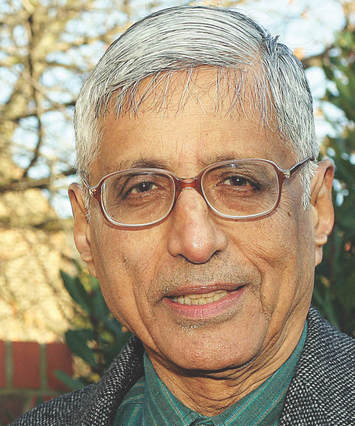
India’s acting High Commissioner in London, Asoke Mukerji, officially launched the British edition of Rajmohan Gandhi’s new biography of his grandfather, Mahatma Gandhi. The packed reception at the Nehru Centre in London, 23 July, was chaired by the BBC’s popular sports editor, Mihir Bose. Rajmohan read extracts from the book, Gandhi, the Man, his People and the Empire, followed by questions from Bose and from the audience. Bose recalled that he was a schoolboy at St Xavier’s College in Bombay when he had first met Rajmohan who had visited the school with Moral Re-Armament (now renamed Initiatives of Change). In response to questioning from Bose, Rajmohan spoke about Gandhi’s sometimes controversial commitment to brahmacharya (celibacy). He had taken a vow of poverty and celibacy in 1906 at the age of 37, ‘feeling his life must be consecrated to some great goal’. He had later admitted that in some aspects, including the sale of family jewellery, he had ‘extorted’ the consent of his wife, Kasturba.
During the violence of Partition in 1947, Gandhi had urged ‘love, understanding, reconciliation, forgiveness’, Rajmohan said. ‘Gandhi felt he needed some extra fire. He felt that he would get this power if he perfected chastity. Satya (truth) was the value that he cherished the most.’ The concept of satyagraha (the force of truth or non-violent resistance) was decided upon when Gandhi was in Johannesburg in 1906: the date was 11 September (9/11). Answering questions about Gandhi’s commitment to non-violence, Rajmohan said that ‘a violent reaction can produce an even more violent counter-reaction and rage.’ And on India’s industrialisation, Rajmohan said that Gandhi ‘wanted industrialisation of the right kind that helped people and it would be untrue to say that Gandhi was opposed to industrialisation.’ Rajmohan added that Gandhi would have welcomed ‘the personal computer as the modern version of the spinning wheel because it empowers people’.
During the course of his questions, Bose asked Rajmohan, ‘What inspired you to join Moral Re-Armament?’ Rajmohan replied that he was still identified with MRA which had now changed its name to Initiatives of Change; that it believed that ‘when I point my finger at my neighbour there are three more pointing back at me’; and that it was ‘absolutely sound philosophy for all time’. He said that some of us had believed, naively, that we would completely change the world ‘in five years’. That of course did not happen. But, he added, ‘Did we make some impact on the world? I believe we did.’ The Indian and British audience included a grandson of Lord Wavell, the penultimate Viceroy of India, 1943-47. India and Pakistan gained their independence from Britain 60 years ago in August 1947. Rajmohan paid tribute to ‘wonderful London’ for the many gifts it has given, including the archives held here which helped him to write his book. Michael Smith
English