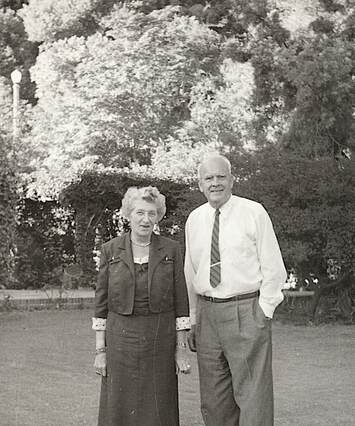
George Lockwood Eastman (1887-1969), born in Potsdam, New York, followed his future wife’s family across the American continent in 1908 to marry and take up residence in Hollywood, California where he lived for the rest of his life. He was a sixth cousin of George Eastman of Eastman Kodak (1854-1932), whom he never met. In Hollywood, he developed a building materials company, the George L. Eastman Company, which, at the time he sold it to Blue Diamond in 1926, was the largest company of its kind west of Chicago. He was a founding member of a number of Hollywood institutions including the First Presbyterian Church of Hollywood and the Wilshire Country Club.
In 1928 he served as president of the Los Angeles Chamber of Commerce. He used his position to go to Washington and put pressure on members of Congress to get the bill permitting the construction of the Hoover Dam out of committee, where it had been languishing, and brought to a vote. The dam would totally alter possibilities for the growth and development of the Los Angeles area by guaranteeing water and hydroelectric power. He also persuaded Walter Chrysler to abandon plans to locate his West Coast headquarters in Oakland and come to Los Angeles instead. At the end of his year as Chamber president, he was voted Los Angeles’s most useful citizen.
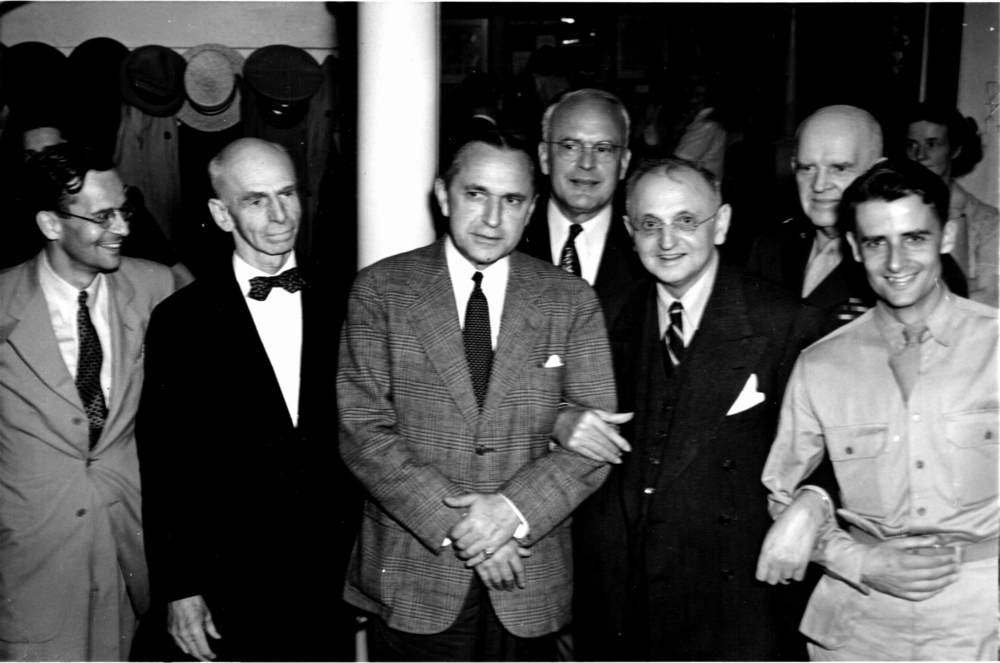
His encounter with Frank Buchman and the Oxford Group in 1933 came at a moment when he had lost much of his wealth in the early years of the Depression. The Group helped him to find a different life goal from personal enrichment. The Eastman home at 8150 Hollywood Boulevard became a hub of the Oxford Group and Moral Re-Armament in the Los Angeles area.During the 1930s George Eastman developed links with the Japanese community of Southern California. In 1939 he was a member of an American trade mission to Japan and was singled out as the one in the group who spoke most frankly of the deteriorating political relationship between America and Japan and his hopes that it could be repaired, which was appreciated by his Japanese hosts.
He picked up his commitment to Japanese-American relations after World War II. In 1950, he was among those who enabled a large delegation of the Japanese leadership to attend the Moral Re-Armament conferences at Caux, Switzerland. Soon after, he became president of the Japan-America Society of Southern California, and in that capacity hosted cultural and consular events in the region and dedicated significant effort to promoting trade and building goodwill between the United States and Japan. He traveled to Japan many times, and in 1964 Emperor Hirohito conferred upon him the Order of the Rising Sun.
George Eastman became a member of Moral Re-Armament’s Board of Directors in 1948 and remained on the Board until his death in 1969. He was instrumental in Moral Re-Armament’s decision in 1948 to purchase the building at 833 South Flower Street in Los Angeles (the former Women’s Athletic Club building) that became the center of MRA activities in Los Angeles, and he donated much time and treasure to that project. The Eastmans took part in Moral Re-Armament’s Statesmen’s Mission in 1955, traveling to a series of Asian countries with the play The Vanishing Island. He was heavily involved in the planning for the construction of Moral Re-Armament’s conference center at Mackinac Island, Michigan, recruiting the same architect who had designed his Hollywood home. He participated in Mackinac’s summer conferences, bringing friends from the movie industry as well as from the Japanese community.
In Moral Re-Armament settings, George Eastman was a spokesperson for the business world of America, and he gave considerable time to meeting trade unionists and expressing his belief that business owners can become generous and selfless when they undertake the building of a better world. Eastman often spoke publicly alongside Max Bladek, a former communist from the German industrial region of the Ruhr. Speaking together as a manager and a passionate member of the working class, the two men shared their experience in crossing social divides and finding a common goal.
Pauline Alber Eastman (1885-1967) was a singer, and she met her husband when she attended the Crane School of Music in Potsdam, New York. Later she taught music at Hollywood High School. The Eastmans had a son, George L. Eastman, Jr. (1909-1997), and a daughter, Pauline Eastman Smith (1916-2000), who both devoted many years to the work of Moral Re-Armament.