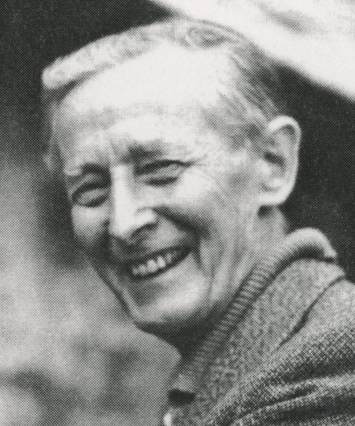
The last time lan talked to us was the night before his final illness, two days before his death. You never knew where a conversation with lan would lead but you could be sure it would be somewhere interesting. So, that night, he talked of the books he was reading — a history of Byzantium, a novel about the Arctic convoys in the war - and of the next book he wanted to write, of his own memories, of war and peace. He enthused about his new computer and the excitement of using e-mail. He was looking forward to seeing us at Christmas and to hearing Amica play her flute. And he talked of his own death and how ready he felt to welcome it. He said he was not afraid. He was full of confidence in the continuity of this life and the next and full of gratitude for everything.
"I woke very early, " he said, "and saw the moming star shining so big and bright, and I thought, whom shall I thank for all this beauty?" I came away from that conversation marvelling at his freshness of mind, the breadth of his interests and concerns and at his inner peace.
lan was bom in Harvey Road, just a quarter of a mile away, in 1913. As a child he played at the pond on the heath, by the Princess of Wales pub. His father, John, was Maltese. He joined the British colonial service and was appointed by the great Lord Lugard as an administrator in Northern Nigeria, with instructions to leam the language, map the country and win the confidence of the local rulers. He and his wife, May, must have been remarkable people. lan had great stories of their adventures: of travelling by ship from England and then being dropped by crane into dug-out canoes with all their possessions, some of which were lost in the surging breakers, and of narrow escapes from a mad hippo and marauding lioness.
As was the way in those days, their children were brought up largely by guardians and a succession of nannies. lan talked recently of how much he missed his parents and of the loneliness of boarding school in Cheltenham, where he was bullied on account of his foreign-sounding name. He decided he would prove himself at something and took up rowing, earning the right to wear the coveted white blazer and trousers of the school crew.
At Oxford, too, he excelled, rowing for the university second eight and becoming a member of the elite Leander club. He always kept the pink club cap, and donned it proudly, with a twinkle in his eye, on a recent Morden College trip to Henley.
A photo from that time shows a man of extraordinary good looks: blond, very tall, powerfully built, hands nonchalantly in his pockets: the epitome of 1930's cool. And yet lan told us he had little confidence in himself in those days and little sense of purpose, although his concem about unemployment, and the international crisis, led him to join the pro-Communist October club. "We wanted to do something different," he said, "to leave the world a better place."
Then he met the Christian movement known as the Oxford Group, and later as Moral Re-Armament. lt turned his life around and gave him a vision of how the world could change if enough people allowed themselves to be changed by the love of God. lt was a vision that won all of lan's young heart and mind and to which he gave the rest of his life. lt sustained him through the tragic death of his brother Bernard, a brilliant pilot, who crashed during an aerobatics display in 1938, and during the war years that followed. lt inspired him to run a training camp for young men on their way to join the army, which paid as much attention to their morale, and their understanding of what Britain was fighting for, as to their ability to dig trenches. One cadet, who became a life-long friend and is here today, wrote of those times: "We would be challenged to expect more of ourselves than we thought possible!"
lan later saw active service as a lieutenant in the Royal East Kent Regiment — the "Buffs" — and was badly wounded in the arm. But he recovered in time to serve with the army of occupation in Germany. That same cadet wrote: "For a brief time I was his driver in the unit charged with investigating the secrets of Germany's war industries. lt was Ian's idea to call on anyone we could find from the German Moral Re-Armament team and remake the links after the separation of war. One such person was Anne-Marie Orthaus. I remember her gasp of surprise when lan gave her two oranges. They had not been seen for years." I like the imaginative generosity of that gesture. So typical of lan.
He loved to quote an Elizabethan writer to the effect that a real man should be able to wield a sword, write a sonnet, and weep easily. lan certainly did his share of combat; and he was never afraid of emotions, happy or sad — in that sense he was as much a Maltese, as an English, gentleman. And he wrote poetry all the time, naturally and wittily, to celebrate a birthday, to praise the achievements of the daughter and granddaughter, of whom he was so proud, to express his appreciation of the staff at Cullum Welch Court here, or to sing his love for Sheena.
When he first caught sight of her, before the war, she was folding linen into a cupboard. She had her back to him, but, he said, "I knew immediately that she was the one." The story of their engagement is typical of his romantic character. lt was May, 1949. Sheena was working in Germany. lan was in England. One moming she looked out of her bedroom window to see lan, below, washing her car. He invited her for a drive — in her car. But he had studied the map carefully, and fixed on a certain spot as the ideal place to make his proposal. The road wound on and on and he began to wonder if he had made a mistake — but at last they came to the place, and it was exactly as he had hoped, with an amazing view, and even a cherry tree, in full bloom. They were married exactly a year later.
In their 50 years together their shared commitment to build a world free from want and war led them to many lands. But the happiest time was the 20 years they spent in Malta, where lan rediscovered his Mediterranean roots. That was when I first got to know him and his huge enthusiasm for the island and its complex culture: the butter coloured houses, the wild, limestone cliffs, the saints days with their processions and firecrackers, and the ancient olive groves, where he liked to imagine St Paul, after his shipwreck, preaching and breaking bread. lan was still giving away oranges, and lemons, too, from his own trees — and we have included those fruits among the flowers on his coffin, to remind us of the warm south.
lan seemed to know everyone in Malta: dockers, fishermen, barefoot farmers, bishops, diplomats. At a time of political tension he and Sheena welcomed people of all parties in their home and shared with them a big vision of what that small island could be: a bridge of peace between Europe and Africa, Christianity and Islam. A Maltese friend said recently: "Malta is different because of lan."
He loved this place, too, and was always saying how thankful he was for the home, and the friends, he and Sheena found here in their last years.
lan always delighted in flowers and plants. Anyone who visited him here will know that on any space not taken up with books or pictures of the family, there would be plants. lan could make anything grow — and not just plants, but people, too. His gift for friendship, his honesty, and his sense of fun, were an inspiration to so many.
Here are some lines from letters Joanna has received:
"Your father made a profound impression on me when I first met him. He had so many character traits I wished I could have — from enthusiasm, a deep care for others, through to a joyful faith in Christ. They all flowed easily from him."
"We shared a room in 1948. I still read every day the Bible he gave me then."
"He showed me so much of the glory of God."
And, finally, from a resident at Morden College, describing the scene in the dining room a short while ago:
"We were just finishing our lunch when I noticed several faces lighting up at the tables around us. I turned to see who it was filling them with such anticipatory joy and found it was Ian, looking very stylish and lively. He moved from table to table, with a joke here and a story there, and then passed on, leaving the room in a very happy state."
Ian, that is what you have done for us. You have passed on, leaving the world a happier place, leaving us happier, and better, for knowing you. Go well now. God rest you. Pray for us, as we pray for you, until we merrily meet again in heaven.
Denis Nowlan
Morden College Chapel, Blackheath, London
3rd Jan 2002
English