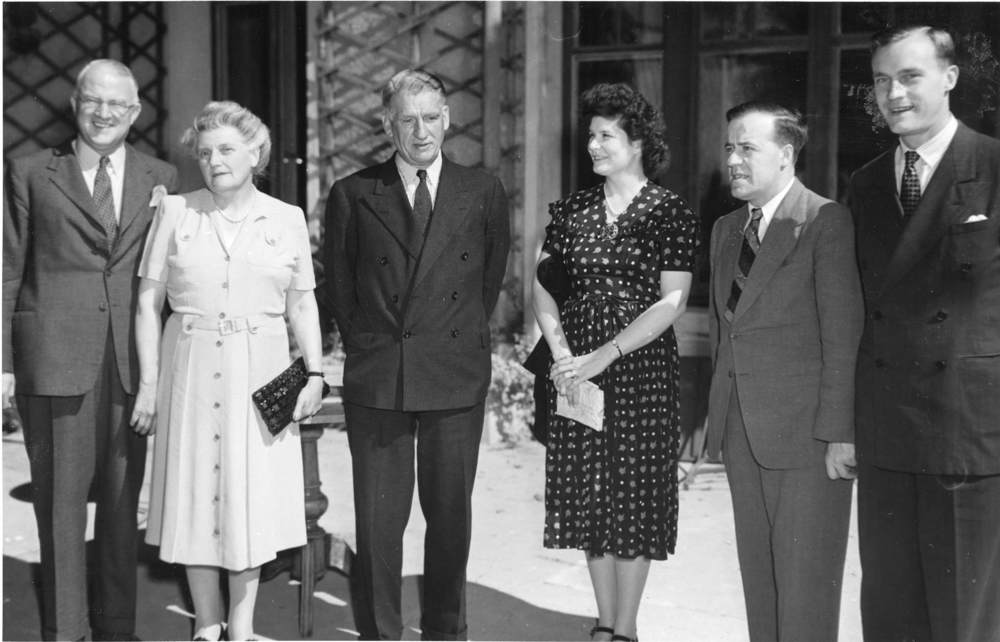
George Stuart Smith (1914-2006), who was born in Kippen, Scotland in the early days of the First World War, encountered the Oxford Group in 1934 when he was a student at Glasgow University. In the next three years, he linked up with other Glasgow University students as an Oxford Group “team” who tried to have an impact on the critical concerns of Glasgow in the Depression years. They befriended and joined forces with trade unionists associated with the shipbuilding industry, and organized camps for unemployed men of Clydeside. In his final year of university, Smith was President of the Glasgow University Student Union and used this role to raise the profile of the Oxford Group men’s activities in the University.
The Glasgow region had come to be known, in the previous fifteen years, as “Red Clydeside,” as Marxism became attractive to workers who were suffering from the decline of industries that had burgeoned in the late nineteenth century. In the mid-1930s, many students were abandoning their studies and going to Spain to support the anti-Franco left in the Spanish Civil War. The Oxford Group offered a faith-based alternative to Marxism, calling upon people of every social status to change their ways of living to address social decay and division.
From Smith’s daughter Margaret Eastman Smith’s memoir A Spectacular Inheritance: What I Kept and What I Left Behind (Sibylline Press, 2026):
Dad had family connections to the same stream of ideas that had inspired Buchman. Dwight Moody, probably the most important American evangelist of the late nineteenth century, took Great Britain and Ireland by storm during an evangelistic tour in 1873-75. In both the US and UK, Moody influenced the growth of a “pietist ecumenism” that sidelined theology and ecclesiastical differences in order to concentrate on the inner life and lived spirituality. Dad’s paternal grandfather, Peter Smith, son of a woodcutter in the Speyside village of Carron, and twenty-two years old at the time of the Moody campaign, went to hear Moody and his evangelical partner and musical sidekick, Ira Sankey, possibly at a meeting in Inverness timed to coincide with the annual wool fair. Peter Smith owed his subsequent vocation to Dwight Moody. He moved south to Glasgow where he supported himself as a shoemaker while attending Glasgow Theological College, then took a church in Lanarkshire.
His eldest son, my grandfather, Peter George Smith, followed him into the church and by 1909 was a minister in the village of Kippen, north of Glasgow. My grandfather volunteered as a chaplain to a Scottish regiment in the World War, developed cancer while overseas, and came home from the war to die in 1919, leaving six young children fatherless.
And so 1919, the year of the Versailles Treaty that was to define the century to come, the year in which whole countries absorbed their epic losses and were propelled forward by the thought that they had survived the war to end wars, was a shattering year for my father’s family. Within the space of eighteen months, my Scottish grandmother lost both her parents to old age possibly hastened by influenza, her beloved youngest brother and her mother-in-law to influenza, and her husband to stomach cancer exacerbated by his wartime service as a military chaplain. She was forced to leave the gracious manse in Kippen, with servants and an idyllic view of the Stirlingshire plain and Ben Ledi in the distance, and move into Glasgow with her six children, the youngest a week old when her husband died. Less than two years later, my father was sent, at age seven, to a charity boarding school.
How did the children made fatherless by that devastating war absorb their losses and plan their future? It is clear to me that for Dad, his sense of the drama of history was a way for him to make meaning of the family tragedy. And joining a Christian community that was responding to recent history with a vision of building a better world pulled many threads together. It interwove his love of adventure, his belief in God, and his need for a sense of family after having the center of his own family life torn from him. The community, the big idea, became the closest thing to home for him.
In addition, Dad undoubtedly recognized themes in Buchman’s work that resonated with his family connection to the evangelical arm of the Church of Scotland. Thus, engaging with Buchman seemed like a natural continuation of family heritage.
i David Belden, “The Origins and Development of the Oxford Group (Moral Re-Armament).” Submission for D. Phil Thesis, St Edmund Hall, Oxford, January 1976. Belden provides a useful in-depth account of the pietist and revivalist influences on Buchman.
ii William G. McLoughlin, Jr., Modern Revivalism: Charles Grandison Finney to Billy Graham(New York: The Ronald Press Company, 1959), 191; quoted in Martyn McGeown, “The Life and Theology of D. L. Moody (with particular emphasis on his British Campaigns).” (Antrim, Northern Ireland: Covenant Protestant Reformed Church website, 2019). https://cprc.co.uk/articles/moody/
Stuart Smith threw in his lot with the Oxford Group, soon to be renamed Moral Re-Armament, in 1937, when he finished university. In March 1939, he was one of a group of Scottish recent graduates who went to Canada and the US to participate in events surrounding the re-launching of the movement as Moral Re-Armament.
In July 1939 the Scottish group were in Hollywood to participate in a rally at the Hollywood Bowl to mark this new moment in the history of the movement. 32,000 people attended the rally. Six weeks later, World War II was officially declared. Smith and others of his Scottish cohorts remained in the US, working with the “Labor Team,” who were getting to know the trade union scene in the United States and orchestrating encounters between trade unionists and management.
Frank Buchman gathered his close coworkers at Lake Tahoe in 1940 to regroup and consider their role during wartime. The musical revue, “You Can Defend America” was a product of this new phase of their work. The revue was conceived as a way to help morale during wartime. When the US entered the war, Smith enlisted and attended Officer Candidate School in Florida. He remained in the US throughout the war, lecturing to new military recruits about the history that had led to the war and the ideas for which these men were fighting. Several other men of Moral Re-Armament also performed this particular service to the US military.
One of those organizing the Hollywood Bowl rally in 1939 was George Eastman, a Hollywood businessman who had become an active supporter of the Oxford Group in 1933.
His daughter, Polly Ann Eastman (1916-2000), also became part of the Labor Team, which is where she got to know Stuart Smith. For American Presbyterians like the Eastmans, the Church of Scotland was the mother church, and set a plausible background for this marriage.
Polly Ann had grown up in Hollywood, attending Hollywood High School and University of California in Los Angeles. She was a singer, and as such participated in You Can Defend America in the 1940s. In the 1950s she travelled for a year with another Moral Re-Armament production, The Vanishing Island, in which she understudied one of the lead singers.
Polly Ann and Stuart Smith were married in Mountain House, Caux, September 30, 1948, and were among the Moral Re-Armament people who helped mount the early conferences at Caux that became significant in Franco-German reconciliation. The Smiths returned to America in 1951, and worked with MRA in Los Angeles and San Francisco. They then continued their mobile life with MRA by going to Tokyo, Japan, 1957-58; various locations in the US 1958-1961; Glasgow, Scotland 1962-1967; London, England 1967-1970; Melbourne and Canberra, Australia and Auckland New Zealand, 1970-1972; Port Moresby, Papua New Guinea, 1973-1975. In 1976 they moved back to the United States once again and lived in Silver Spring, Maryland, in the Washington, DC suburbs, from 1976-1994. They lived their final years in Santa Barbara, California.
They had one daughter, Margaret, born in Lausanne, Switzerland in 1949, who now lives in the United States.