Thio Chan Bee
Thio Chan Bee was a schoolmaster and educator from South-East Asia. He was born on 5 April 1904 in Medan, Sumatra, the second of six children of a grocer. After his father's business collapsed, he was sent to Singapore in 1915 to study at the Anglo-Chinese School (ACS). There, according to Singapore's National Library, he came top in Singapore in the Standard VII, Junior Cambridge and Senior Cambridge examinations between 1918 and 1920.[1] foranewworld.org records his nationality as Malaysian.
He joined ACS as a trainee teacher in 1921 and qualified the following year, and in 1934 he earned an honours degree in history from the University of London. He kept teaching through the Japanese Occupation. After the war he served as acting senior inspector of schools and led the reorganisation of Singapore's schools between September 1945 and July 1946. He returned to ACS as vice-principal in 1947, and in 1952 he became the school's first Asian principal, a post he held until 1960. As principal he replaced the prefect system with a School Welfare Council and favoured counselling over corporal punishment. He also sat on the 1948 select committee whose work led to the founding of the University of Malaya, and he campaigned for Singapore's first polytechnic, joining its board of governors when it opened in 1954.[1]
His encounter with Moral Re-Armament changed the course of his public life. After attending the MRA conference in Caux, Switzerland, in 1946, he resolved to act as a bridge between Malaya's communities. He worked behind the scenes to bring together the Malay leader Dato Onn bin Ja'afar and the Chinese leader Tan Cheng Lock, a 1948 meeting that eventually led to the alliance between UMNO and the MCA.[1] On foranewworld.org his link with MRA is documented from 1948, when he was photographed with Dr Sih Kwang-Tsein, chargé d'affaires at the Chinese Embassy in Berne, and V. G. Dalvi, general secretary of the Indian postal workers' union. He also appears in reports in New World News from 1948 and 1951, and he spoke at a Caux meeting on 4 June 1954.
His political career began in May 1946, when he became a non-official member of Singapore's Advisory Council. In 1948 he joined the Singapore Progressive Party, serving as its vice-president at various times until 1955, and he was made a justice of the peace. He was nominated to the Legislative Council in 1948, won the Balestier seat in 1951 and sat on the Executive Council from 1951 to 1955. He lost the Whampoa seat in 1955, won the Tanglin seat in the Legislative Assembly for the Singapore People's Alliance in 1959, and lost it to E. W. Barker in 1963. In the councils he pressed for education reform, public housing and social welfare, and he was the first member to propose provident funds for workers, the idea behind today's Central Provident Fund. As early as 1948 he proposed a "Confederation of Malaysia" of Malaya, Singapore and the Borneo territories, to be reached in stages.[1]
His main work was building trust across racial and political divides between Singapore and Malaysia. In the 1970 film Asia's Destiny, he is introduced as an eminent Chinese educator from Singapore. He describes his wish to improve relations between the two countries, and how he was guided to meet Tan Sri Syed Jaafar Albar, who had been regarded as public enemy number one of Singapore's Chinese community. The two men were later photographed together, and in 1970 Thio Chan Bee sat on Albar's Committee of Hosts in Malaysia for the musical "Anything to Declare?". From 1964 to 1970 he was education secretary for all Methodist schools in Malaysia and Singapore, and in 1968 he founded the Association for the Promotion of Higher Education in Malaysia, to use education to build understanding between races and religions.[1]
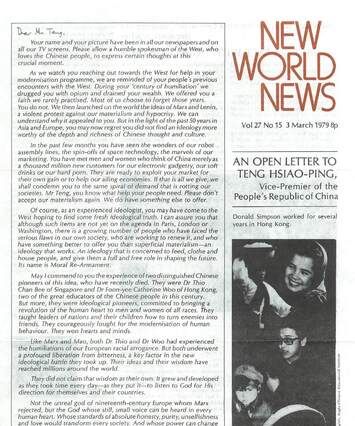
In 1977 he published his autobiography, Extraordinary Adventures of an Ordinary Man (Grosvenor Books). It tells how a schoolmaster quietly helped resolve communal differences, get opposing politicians to work together and build trust between labour and management. Malcolm MacDonald wrote the foreword and called the book a real contribution to contemporary history. Thio Chan Bee continued to appear in MRA publications, including New World News in 1979.
He was made a CBE in 1955, received an honorary Doctor of Laws from the University of Malaya, and in 1965 was awarded Malaysia's Johan Mangku Negara. In 1926 he married Ong Hay Way; their daughter Eunice became the first woman promoted to full professor at the University of Singapore. He spent his later years in Malaysia and died of colon cancer on 13 December 1978. ACS and the association he founded have endowed scholarships in his name.[1]
External sources
- Singapore National Library, accessed on 15/10/2026